
You may have seen members of the Strava community bombing down your street on a bike or dashing, fleet-footed, through your local park. The users are many. As an application that pits runners and cyclists against each other using GPS to turn streets into racetracks, it is showing how smart phones can blur the lines between online and offline communities.
In a conversation on Quora, Strava developer Leo Romanovsky indicated that Strava athletes log two million activities a week, which, if we estimate 3 activities per user, would mean Strava has around 666,666 active users.
It works like this: you strap a phone to your bicep or strap up to a GPS device and hit the road. Users nominate different “segments” of tarmac and each has a leaderboard. It’s a race to the top.
In 2013 athletes logged activities in every country on Earth, (a total of 905,408,836 miles), and although Strava remains most popular in the US and UK, it has recently garnered support from other countries.
There is a major competitive element to Strava. Many people look to move up the results page either against the community in general or against friends. It can be quite intimate: you can view a person’s run in detail, and even look at their heart rate.
Strava is different to similar services such as Map my Run and Nike+ because it plays perfectly on the border between an online community and an offline one. It encourages people to interact in both arenas and pushes both bonhomie and hard competition.
One of its biggest triumphs is its use of an open API. This allows third party apps and tools to grow around the community, such as sites to analyse activities in greater detail. One developer was even hired after he created an app. This shows a good understanding of social media: it is better to build a tool and let the users decide how to use it.
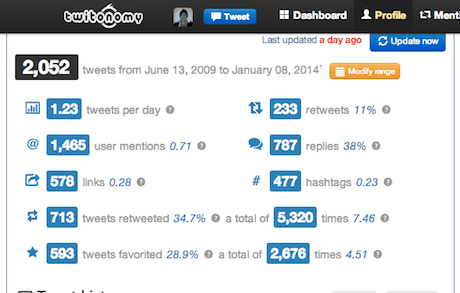
Strava interacts interact strongly with users: 71% of tweets contain a user mention and the most mentioned users are athletes, not staff.
Twitter is used by the community to share rides, runs and photos, and Strava retweets activities with inspiring images, encouraging athletes looking for validation from the community. These images are usually linked to Instagram.
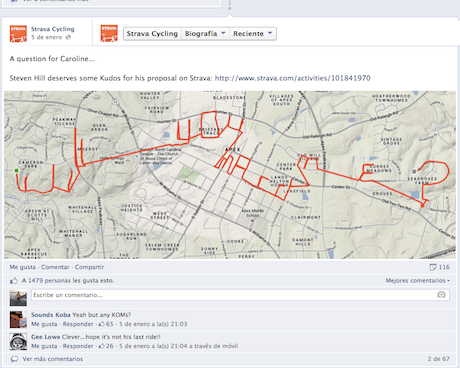
Strava uses Facebook to promote its features and challenges, and encourages sharing with requests like “share your indoor torture chamber”. Users respond very positively when asked to share activities or photos, and this is encouraged by Strava’s highlighting of certain users’ activities.
Strava has recently allowed athletes to update their activities by posting images to Instagram during runs or rides. Strava staff also post photos here, and choose the best ones to showcase on Facebook.
Strava’s popularity has even spread to some professional athletes; Laurens Ten Dam used Strava to record his ride to 13th place in the 2013 Tour de France.

1 thought on “Analysis: How this running & cycling app creates a community of competitors”