
What do Edward Snowden, Corn Exchanges, erotica for women and fish and chips all have in common?
They are just some of the topics that feature in the first issue of Contributoria, the new crowdfunded collaborative journalism platform launched last month.
Backed by the Guardian Media Group (GMG), Contributoria allows its community of journalists and interested readers to decide what articles they would like to see written and support each pitch accordingly – with the community involved in all stages of an article’s development.
GMG’s general manager of new digital business Matt McAlister is part of the team and developer Dan Catt, who helped build Flickr in the early years of Web 2.0, is also on board. Sarah Hartley, media trainer and multimedia journalist is Contributoria’s editor.
Right now the site is free for anyone to join (but expect this to change to fuel the commissioning process), and it has been hailed in a recent article on FastCoLabs, as what “the baby” of blog publishing site Medium and crowdfunding platform Kickstarter would look like if they reproduced.
Ultimately though its underlying aim is to enable the creation of transparent, high-quality collaborative journalism that might otherwise not have been produced.
So after a successful first month, Interhacktives talked to Hartley about how Contributoria is making collaborative, transparent journalism work for them.
How would you describe Contributoria in a few words?
Community-funded collaborative journalism.
What do you want to achieve with Contributoria?
A sustainable community for quality journalism. We want to enable the creation of some great journalism which might not otherwise have been funded.
How does it work?
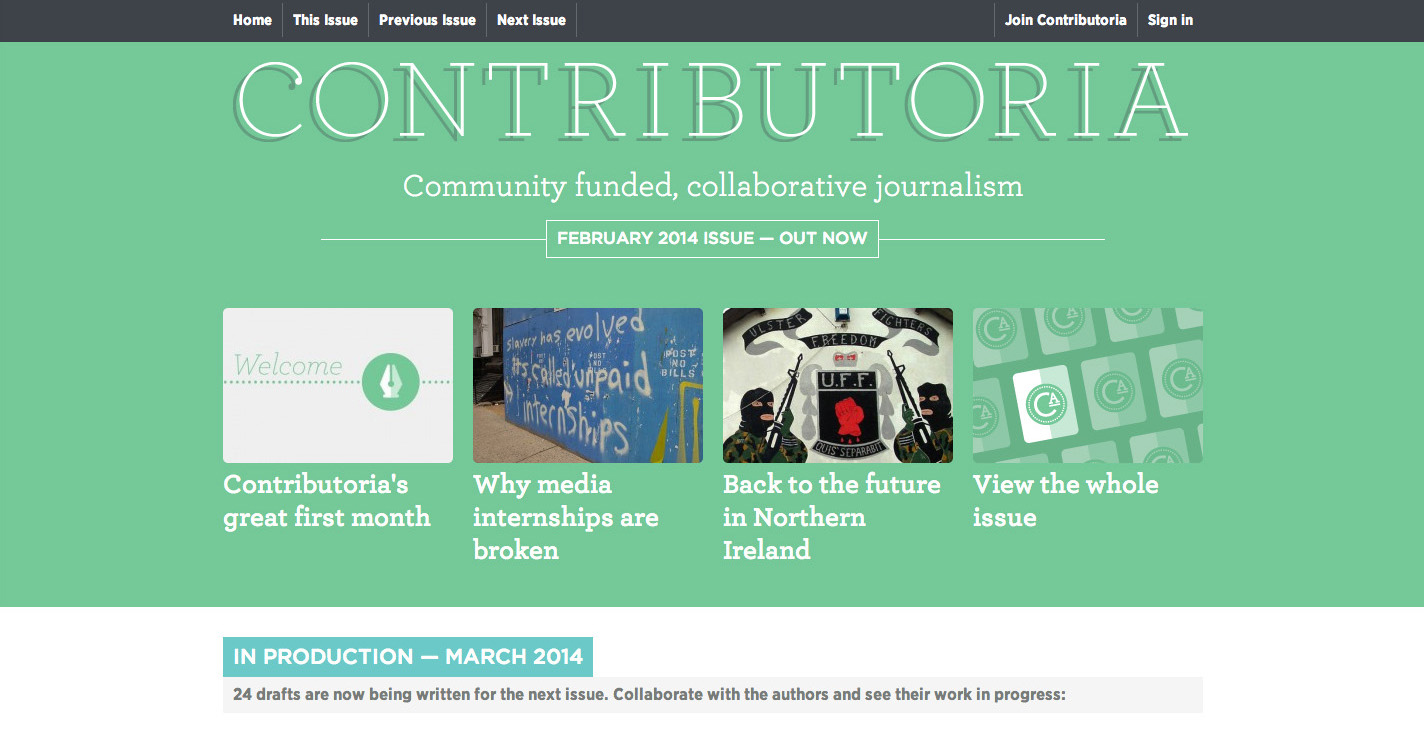
It works over three stages – planning, production and publication.
During the planning stage, writers propose their stories and answer any questions members might have or points they wish to raise. Members on the site then choose which stories they’d like to back.
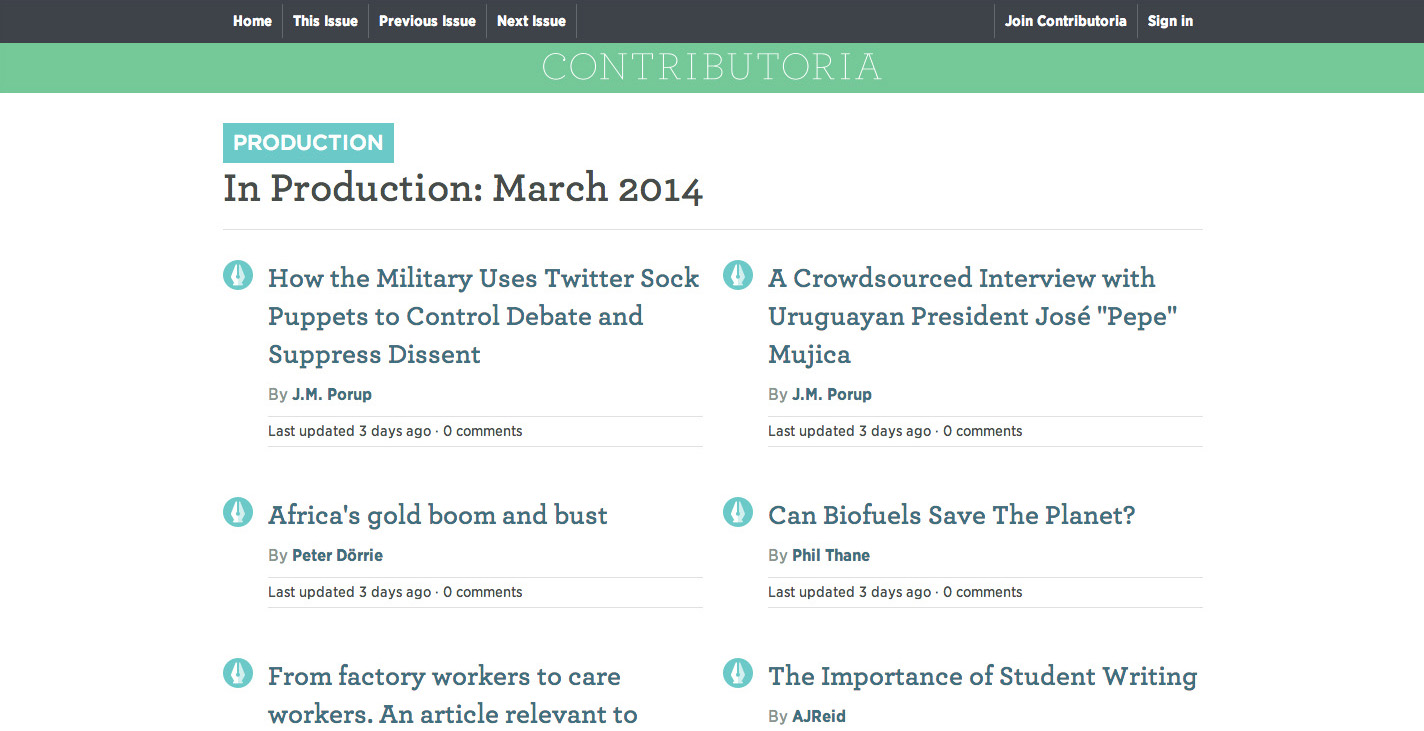
During the production stage, articles are drafted and worked on by the writer together with members of the Contributoria community. This stage is only available to members and is not visible to the wider public.
Finally the completed article is published in an edition, a bit like an online magazine.
We believe that bringing some transparency to the process of journalism will help restore public trust into journalistic activity at a time when that is being eroded in many quarters
Is the model of ‘open journalism’ feasible in the way that Contributoria envisages it?
We believe it is feasible and hope Contributoria will demonstrate that an open approach can work and will actually result in better journalism. We believe that bringing some transparency to the process of journalism will help restore public trust into journalistic activity at a time when that is being eroded in many quarters.
Do you see this as a model that ‘traditional’ newsrooms could potentially adopt?
The idea of a ‘traditional’ newsroom is also changing rapidly. Like ourselves, many news organisations seek to find new voices and new ways of funding their journalism and Contributoria will test a new way for a community to commission articles of interest.
How did the idea for Contributoria come about?
We came up with the idea for an open competition on news innovation which was held by the International Press Institute (IPI) and sponsored by Google. The prize money funded a prototype for the site and then the Guardian Media Group agreed to support us to make it a reality.
Copyright for the articles remains with the author and Contributoria.com will help writers interested in syndicating their material further afield.
How is it being funded?
Initially from the IPI, currently by Guardian Media Group and eventually through a paid membership model based on cooperative principles. We are also seeking funding from interested partners and sponsors.
Note: After this interview was conducted, Contributoria announced the IPI as their first sponsor. The IPI will sponsor the April issue, which is themed around Press Freedom.
How does the system for payments to contributors work?
The writer sets the fee they are happy to receive in pounds and pence. This is then translated by Contributoria.com into ‘points’ and members choose where to allocate their points. If a writer is backed and goes on to produce the article, they will be paid for their work. Further paid opportunities can also arise if another publisher wishes to use the completed article. Copyright for the articles remains with the author and Contributoria.com will help writers interested in syndicating their material further afield.
How have people reacted to it during the first month?
We’re just approaching the end of the first month and the response has been amazing. We’ve had a lot of press interest in the UK and overseas but the best reaction has come from the hundreds of people who’ve signed up to be members and writers and who have been so enthusiastic and supportive. We’re really pleased with how it has started.
Following this interview, Contributoria released a more detailed overview of their first month, announcing that more than 650 new members joined, 65% of which are writers. Its members backed 24 projects and Contributoria will be paying out over £7,500 to fund them. These included pitches about sustainable fashion in Cambodia, an investigation into public donations to UK charities and the intriguingly titled ‘How the Military uses Twitter sock puppets to control debate and suppress dissent’.
We look forward to seeing these projects, and others, come to fruition.
Check out more of our interviews with the biggest names and brightest sparks in digital journalism:
Interview with Andrew Hill data scientist at CartoDB
Interview Luke Lewis of Buzzfeed (Part 1) – ‘We’ve struggled with sports’