
Deepfake technology has been described as “perhaps the most immediately tangible, damaging application” of artificial intelligence. The tech enables the complete fabrication of images, audio or video and also the projection of someone’s likeliness onto another individual, resulting in endless opportunities for disinformation. This potential has been evidenced by recent political scandals, fabricated wartime photos and deepfake videos of celebrities. These events have raised questions about the responsibilities and the role of social media platforms in identifying and flagging deepfake content.
The importance of being able to identify deepfakes is key, yet a recent study has shown that individuals are unlikely to be able to spot them. At the same time, as a user scrolls through social media they are ever more likely to be exposed to deepfake content. This is why it is argued that it is critical for platforms to identify a solution to help users identify deepfake disinformation.
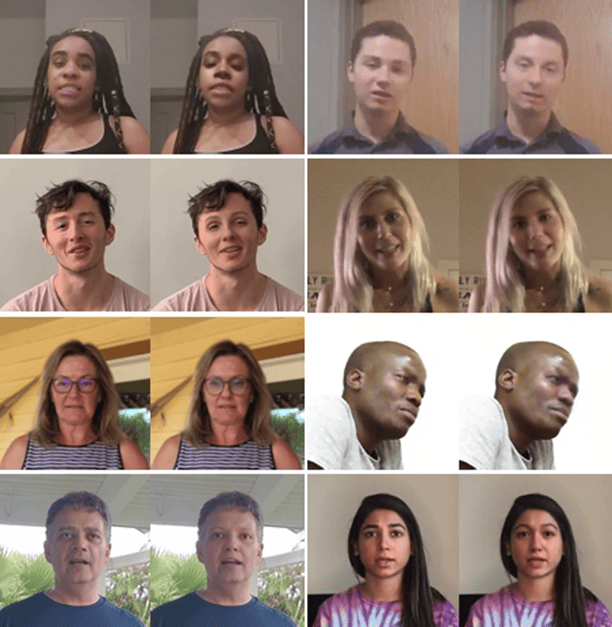
The study suggests that if content warnings are to be one method of informing users that a video is a deepfake, it is important to investigate how useful these warnings are. The paper asks: ‘does a prior warning that at least one video they will view is a deepfake enable individuals to then distinguish between authentic and inauthentic videos?’
The research found that even when the subjects were told that at least one of a series of videos had been doctored, the majority of participants (78.4%) were still unable to reliably identify the only deepfake video.
As a result, the paper suggests that “If we wish to know with certainty whether a video is fake or real — and we have imperfect ability to manually detect deepfakes — we will necessarily have to outsource this judgment to an external source of authentication”.
To explore what exactly this means, we asked Andrew Lewis, one of the authors of the research article, what form these external authenticators might take, and whether a feature such as community notes on Twitter would be fit to occupy this role. Andrew told us that “External as used in the paper means external to the individual, so community notes is definitely an example of a system like that” However, “with deepfake detection it may be more likely for social media companies to have their own in-house detection tools, rather than crowd-source corrections”
Currently, there are a variety of enterprises which sell their own technology with the ability to reliably detect deepfakes. It could be that social media platforms outsource detection to these businesses, or integrate their technology into their sites.
However, one worry is that deepfake technology is developing at such a rapid rate that detection algorithms will fall behind. In a BBC podcast, one expert said that detection tools are “losing the arms race”. However, Andrew takes an optimistic stance, saying: “I’d say never discount ingenuity — these tools progress because of the talented people pushing them forward, so we just need to fix up the incentive structure such that those people are inclined to help with detection rather than creation” He also explained how “there are certainly ways to increase one’s capacity to spot deepfakes”. Click here for a guide on how to spot deepfakes.