
During Social Media Week I live-blogged from the intriguingly-titled event ‘Twitter, the Butterfly Effect and the Future of Journalism’.
Paul Lewis, Special Projects Editor at the Guardian talked about how Twitter works best as a collaborative tool, while Anna Doble, social media producer at Channel 4 News revealed that Jon Snow and Krishnan Guru-Murthy check Twitter obsessively during bulletins.
My highlight, though, was a presentation by Andrew Walker, co-founder of Tweetminster.
For the uninitiated, Tweetminster is an aggregated news platform that focuses on current affairs. It cherry picks content according to what experts are talking about and is entirely driven by data. In other words, it helps make sense from the social media noise.
Andrew talked about Tweetminster’s six-month analysis of the Twitter-ings of 8,000 ‘news influencers’ including MPs, government departments, councillors and NGOs.
The aim was to compare the consumption of news media (news from traditional journalistic sources like newspapers, TV channels and news agencies) versus ‘newcomers’ (so news via bloggers, curation, downloads and so on).
Between 1 August 2011 and 31 January 2012, Tweetminster scruntinised 64,831 shared news links from their elite group of tweeters. Their key observations were;
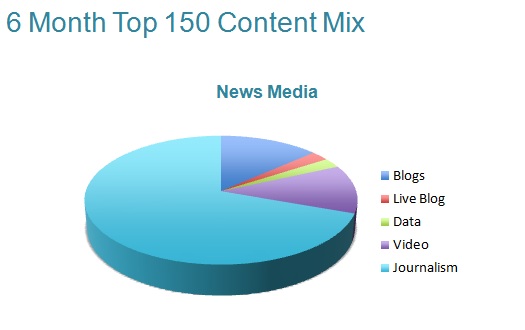
- News media journalism is still the biggest single shared type of content, but not the majority of news consumed
- The likelihood of a URL getting shared is pretty much even between the two types of news. News brands get more URLs shared, but have a lower average share per URL
- When you compare expenditure on SEO and marketing, news media get a lower ROE (return on engagement) than newcomers
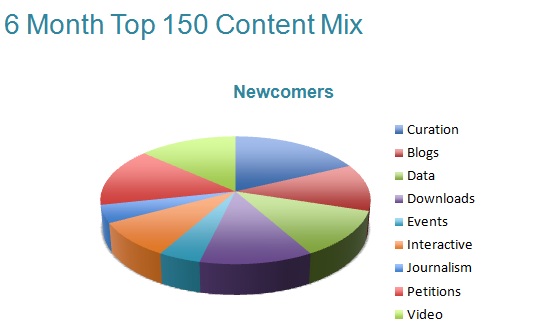
- New ways of consuming news – interactive content, data and video – are more sharable than traditional journalism. This gives newcomers the edge, because as Tweetminster’s analysis also shows, the links newcomers disseminate are much more diverse and interesting;
But what does all this mean?
Tweetminster’s analysis shows that trends in news consumption favour newcomers because they are agile and great at engaging their audience. In the jam-packed 24-7 media environment, newcomers carve their own path – offering niche benefits including curation, specialisation and innovative news formats.
“To get maximum reach, journalists must engage with data, communities, video, mobile and live polling – diverse content is the future of news.”