When the Labour Party’s Michael D Higgins was officially confirmed as the ninth Irish president on 29 October 2011, it was described as “one of the most remarkable comebacks in the state’s history.”
But what triggered this turnaround – and the collapse of his biggest rival, the independent candidate Seán Gallagher? A Gillian Duffy style-encounter? A misguided policy pledge?
No – 91 characters.
Gallagher, a star of Ireland’s version of Dragon’s Den was sailing to victory as the election campaign hurtled towards a conclusion. A poll in the Irish Times just four days before the ballot put his share at a comfortable 40 per cent, well ahead of Higgins at 25 per cent.
That was, until tweeter @McGuinness4Pres put a proverbial spanner in the works.
Imagine the scene. Here’s a picture to help you.
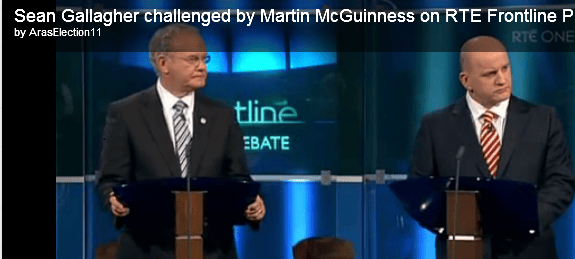
24 October. Three days before the election. A live debate – the last before the election – on the RTÉ show Frontline. All seven presidential candidates are present.
After some heated discussion about the integrity of Gallagher’s activities with the Fianna Fáil party, Sinn Féin’s Martin McGuinness claims that he has spoken to a man who says he gave Gallagher a €5,000 cheque at a fundraiser in 2008. Cue some strenuous denial; “that is not correct,” Gallagher says.
Host Pat Kenny then reads out the following tweet, seemingly from Sinn Féin.
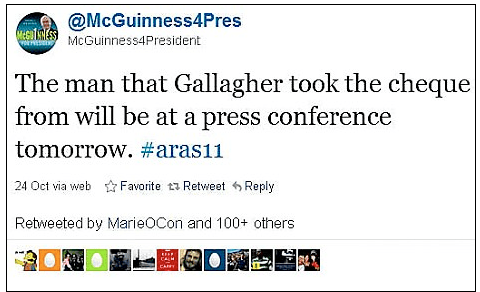
The tweet visibly rattles Gallagher. He falters as he responds and the audience jeers. Repeatedly. He then caves in and admits that he may have received “an envelope” for Fianna Fáil from someone he describes as a “convicted criminal and fuel smuggler.”
“If he gave me an envelope I . . . if he gave me the cheque it was made out to Fianna Fáil headquarters and it was delivered and that was that.”
And with that sheepish admission, and further accusations about an irregular company loan, came an almost instantaneous collapse in Gallagher’s support.
In the aftermath of the election, Gallagher’s press advisor Richard Moore said:
“Before 900,000 viewers on a live TV show that can be earth shattering. And it was earth shattering. There’s no doubt about it but that it was – not the only reason – but probably the principal reason as to why apparently so many people deserted his campaign in the last 48 hours.”
It later transpired, in an investigation by the Irish Mail on Sunday, that the tweet did not come from the official McGuinness campaign account nor Sinn Féin, but a social media manager from Dublin who denied any political allegiance and stated he was simply “tired of corruption in Ireland.”
Mr Gallagher’s team said they would lodge a formal complaint and blasted RTÉ for not checking the authenticity of the tweet.
But it was too late – Gallagher’s support plunged to 28.5 per cent come election day and Higgins romped home with a commanding 39.6 per cent share of the votes.
The lessons here? Apart from highlighting the importance of a) not accepting cheques you shouldn’t b) then denying it – and c) verifying Twitter sources, the incident attests to the power of social media to steer the political agenda.
Rumours were already swirling around Gallagher, so in the circumstances it was delivered – in the full glare of TV cameras and the nation, with no support team close at hand for the floundering candidate – this tweet, irrespective of it being a hoax, acted like a flame to a tinder-box.