When looking at recent changes to the Facebook and Google News interfaces, a common factor soon becomes apparent – increasingly overt personalisation.
Facebook has undergone countless tweaks since my generation first logged in half a dozen years ago, but the last round of modifications include the ‘subscribe’ function, which allows users to filter out content they see as irrelevant and focus on their principle areas of interest.
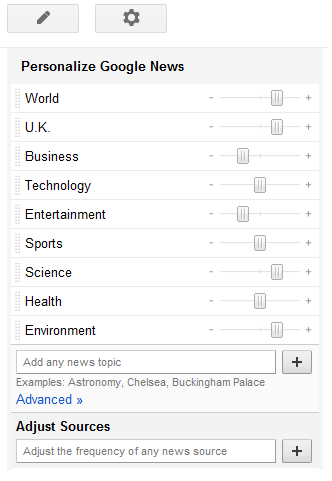
At the same time, Google News is now as individually customisable as it has ever been. The home page includes a “Personalize your news” button, which, when selected, brings up a series of sliders. Each slider represents a news topic – environment, U.K. or sports, for example – and the number of stories appearing on the user’s home page from each topic will depend on the relative positioning of different sliders.
Possibly even more significant from a purely journalistic perspective, users can declare a preference for news articles from certain sources – the Daily Mail or the Economist for example. While said preferences do not go as far as to filter out content from all other publications, this still marks a significant step in the portrayal of news, as users can now create their own source-biased news aggregator. While this may seem unimportant given that most people will simply trawl their favourite newspaper’s website for the latest stories, the fact that Google News still appears and feels impartial after preferences have been stated should not go unnoticed.
The changes on both sites appear to have been well received by users, but more pertinent to the question of whether the trend will continue is the fact that personalisation is massively beneficial to the sites’ owners.
Both Google and Facebook take the vast majority of their revenue from advertising, and ads can be sold at a much higher price when buyers know that their audience will have a specific interest in their product or service. The most up-to-date figures for the growth of online advertising revenue show an increase of 24.1% in the last twelve months (US advertising revenue, study carried out by PricewaterhouseCoopers and the Interactive Advertising Bureau), and if the degree of personalisation of online content continues to grow at current rates, it is reasonable to expect that revenue growth will also hasten.
I think there are limits to the personalisation drive which are well explored in this post from earlier in the year: http://www.thoughtgadgets.com/2011/05/why-1to1-personalization-hasnt-arrived.html
Also I’ve been collecting links on the topic at http://delicious.com/paulb/personalisation
Cheers Paul, that post makes for very interesting reading. I’m inclined to agree with the commenters on it (who offer counter arguments to the idea that true 1:1 personalization won’t take off), although I almost certainly do so from a far less informed position than the post’s author.